Metal Foam Foundry Filter—Compared To Other Filtering Methods
Oct 11, 2022
Barbed wire filter
Because the wire mesh filter has a basically stable filtering effect and relatively low cost, it occupies a place in the traditional casting method.
However, it inevitably increases the content of Fe in the aluminum alloy liquid, it will have an adverse effect on the mechanical properties of the product. In addition, in the process of continuous production of die casting, it is difficult to effectively remove the barbed wire before the casting is completely solidified, and it is difficult to discard the pouring riser charge that contains a large amount of iron.
It is a thorny issue to how to directly carry out low-cost recycling and remelting to reduce the iron content of the melt.
Glass fiber filter
In terms of interception effect, the effect of fiber mesh and barbed wire with the same mesh is similar. As a low-cost filter material, glass fiber filter has quite a good process adaptability.
Experimental studies have shown that even a glass fiber filter with a very small amount of resin will generate a certain amount of gas under the high-temperature conditions of alloy casting. At the same time, due to the characteristics of the material, the filter effect of the fiber mesh on impurities is not very thorough, which will cause a certain amount of defects such as pinholes and oxide slag holes in the casting.
In addition, glass fiber is brittle, has poor wear resistance, and poor ductility. Glass fiber filters are easily damaged, so be very careful when replacing them.
Foam ceramic filter
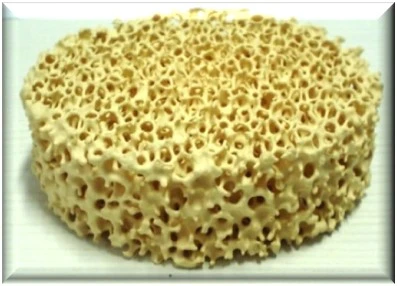
The use of foam ceramics for in-mold filtration and the filtration of aluminum alloy liquid in the intermediate process is a relatively advanced filtration method before the emergence of new foam metal materials. At present, the porosity of ceramic foam can reach 70-90%, and it is widely used in aluminum castings, copper castings, and iron castings. The basic principle of using foam ceramics to filter is to remove the slag in the alloy liquid by adsorbing the gas in the alloy liquid and mechanically intercepting impurities in the process of alloy liquid passing through the fine pores, thereby reducing defects in castings and improving the appearance quality of castings and mechanical properties.
However, the strength of foamed ceramics mainly depends on the thickness of the ceramic material and network skeleton, so it has limitations in technology. In addition, the poor ductility of the material leads to a high probability of crushing and a high rate of slag dropping.