


What Is Conductive Foam
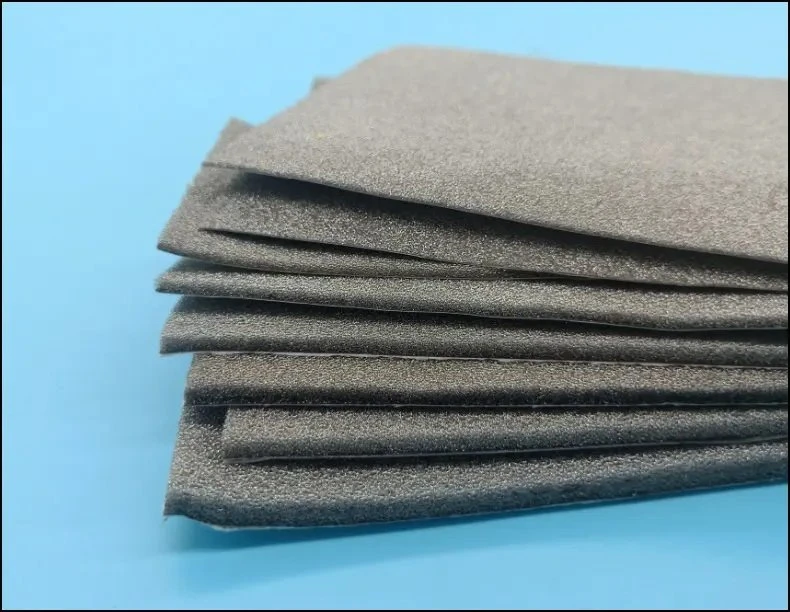
Conductive foam is a type of polyethylene foam that is filled with carbon. It is generally identifiable by its black coloring and has a surface resistance of less than 106 ohms. Conductive foam protects electronic devices and components by acting as a Faraday cage, which blocks electromagnetic fields from reaching whatever it is surrounding. This type of foam makes it not necessary to place the item in something that will shield it from outside electrostatic charges. Conductive foam is known to drain batteries if their conductive ends come in contact with the foam. Be sure to shield batteries from the foam if you are using this type of foam to ship or store electronic devices by using a layer of insulation or another type of static dissipative foam.
Advantages of Conductive Foam
Compressibility
Conductive foam can be compressed over 50%, with minimal force allowing it to fill gaps and provide reliable contact without contributing strain to mating hardware.
Rebound And Resiliency
Resistance to permanent deformation in the form of low compression set and the ability to rebound to its original height are outstanding when tested at 70°c.
Grounding And Coupling
A surface resistivity of 0.12 ω/sq and x, y, z conductivity provide a low resistance path for low amperage grounding currents to flow.
Shock And Vibration
Energy absorbing formulation reduces vibration transmission and can absorb shock without breaking electrical contact.
-

Thickness: 0.1-15mmLE/PPI: 46-62LE/80-135PPIDensity: 28-60kg/m³Width: >1030mmColor: silver GrayX-Y axis resistance: ≤0.5ΩZ-axis resistance: ≤0.1ΩShielding performance:
Add to Inquiry -
Thickness: 0.1-15mmLE/PPI: 46-62LE/80-135PPIDensity: 28-60kg/m³Width: >1030mmColor: silver grayX-Y axis resistance: ≤0.5ΩZ-axis resistance: ≤0.1ΩShielding performance:
Add to Inquiry -
Thickness: 0.1-15mmLE/PPI: 46-62LE/80-135PPIDensity: 28-60kg/m³Width: >1030mmColor: silver grayX-Y axis resistance: ≤0.5ΩZ-axis resistance: ≤0.1ΩShielding performance:
Add to Inquiry -
Thickness: 0.1-15mmLE/PPI: 46-62LE/80-135PPIDensity: 28-60kg/m³Width: >1030mmColor: silver grayX-Y axis resistance: ≤0.5ΩZ-axis resistance: ≤0.1ΩShielding performance:
Add to Inquiry -
Thickness: 0.1-15mmLE/PPI: 46-62LE/80-135PPIDensity: 28-60kg/m³Width: >1030mmColor: silver grayX-Y axis resistance: ≤0.5ΩZ-axis resistance: ≤0.1ΩShielding performance:
Add to Inquiry -
Thickness: 0.1-15mmLE/PPI: 46-62LE/80-135PPIDensity: 28-60kg/m³Width: >1030mmColor: blackX-Y axis resistance: ≤1.5ΩZ-axis resistance: ≤0.5ΩShielding performance: 40(Min)10Mhz-18Ghz/60-90dBTemperature
Add to Inquiry -
Thickness: 0.1-15mmLE/PPI: 46-62LE/80-135PPIDensity: 28-60kg/m³Width: >1030mmColor: silver grayX-Y axis resistance: ≤0.5ΩZ-axis resistance: ≤0.1ΩShielding performance:
Add to Inquiry -
Thickness: 0.1-15mmLE/PPI: 46-62LE/80-135PPIDensity: 28-60kg/m³Width: >1030mmColor: silver grayX-Y axis resistance: ≤0.5ΩZ-axis resistance: ≤0.1ΩShielding performance:
Add to Inquiry


why choose us
Our factory
Yi Yang Foammetal New Material Co., Ltd. is a factory that produces porous metal materials. We have been specialising in this field for over 10 years since our establishment in 2015.
Our products
Our primary products include high-quality metal foam, EMI shielding materials, and surface electroplating metal materials. Our range of products includes nickel foam, copper foam, iron foam, and iron-nickel foam. We also offer conductive foam, conductive fabric, and conductive fabric tape for shielding purposes.
Professional team
We have our own R&D team and 28 patents. R&D team and advanced technics to effectively provide all kinds of standard products and customized products. There are advanced continuous production lines independently designed and invented.
Our service
24-hour online pre-sales and after-sales service to provide you with a professional and timely response. We have been exporting for nearly ten years, and have accumulated rich experience. We are familiar with documents, certificates and export procedures to provide you with professional export services.
Conductive foam is a polyethylene foam filled with carbon (as are all black ESD foams), giving it its conductive properties and colour. Conductive foam is designed for repeat use and will act like a Faraday cage when an item is fully enclosed within it. Your business can take advantage of GWP’s expertise in the creation of conductive foam inserts to work alongside the wide selection of conductive and ESD safe packaging, handling and transit products. The conductive foams you can source help to minimise the effects of electrostatic discharge on sensitive electronic equipment.
With years of expertise in the fabrication of foam inserts and a modern design and production facility including the latest CAD software and CNC machining, you can also benefit from the design and manufacture of a conductive foam solution that will offer the optimum level of protection regardless of your end application. Conductive foam is similar to standard packaging foams but with one crucial difference – the addition of carbon to the polymer mix during the manufacturing process to provide a high level of conductivity. This allows any electric current to pass through the cell structure of the foam and away from the component.
Generally, the foam will have permanent conductive performance, meaning it is ideal for multi-trip packaging and in-plant handling applications. Its performance isn’t affected by atmospheric conditions. This ESD safe material will typically have a surface resistivity of fewer than 104 ohms/sq. and a volume resistivity of fewer than 104 ohms/cms, which offers a quicker transfer of any static charge to a grounding source or adjacent conductive material.
How Conductive Foam Works
While conductive foam is similar to standard packaging foams, there is one crucial difference – the addition of carbon to the polymer mix during the manufacturing process to provide a high level of conductivity. This allows any electric current to pass through the cell structure of the foam and away from the component. Thus, a static shielding bag is not needed as an outer container when using conductive foam. The foam will have permanent conductive performance, meaning it is ideal for multi-trip packaging and in-plant handling applications. Its performance isn’t affected by atmospheric conditions such as humidity. This ESD safe material will typically have a surface resistivity of fewer than 10^(4) ohms/sq. and a volume resistivity of fewer than 10^(4) ohms/cms, which offers a quicker transfer of any static charge to a grounding source or adjacent conductive material.
Custom conductive foam controls electromagnetic radiation that is emitted from low cycle applications. This includes input shielding and rectangular strips. Although there are several materials for conductive foam, most are made from polyurethane foam that is plated with copper and nickel. Once combined, the materials are compressed for 75% degrees ranging between 60 and 70 Celsius. Polyurethane is commonly used because it protects the foam from environmental impacts. There are many benefits engineers find when using conductive foam, so it is often implemented in protecting against and from EMI. Foam provides low compression sets, which means that gaskets have long-term performance ratings. Because of its many benefits, conductive foam is used in many of our everyday devices, including smartphones, cable trays, and noise filter cores.
Characteristics And Typical Applications Of Conductive Foam
Conductive foam or conductive gasket is a gap shielding material, which is light, compressible and conductive. It is often used to provide conductive connection and shielding at gaps in electronic and electrical equipment. Foams are divided into open-cell foam, half-cell foam, closed-cell foam, and micro-cell foam according to the pore structure; according to the material, they can be divided into silicone foam, polyurethane foam, PE foam, PP foam and Acrylic foam, etc. At present, the common conductive foams are mostly FOF (Fabric-over-foam) foams composed of conductive fiber cloth or metal foil wrapped with low-compression polyurethane foam, as well as directly foamed polyurethane foams. Electroplating forms an omni-directional conductive foam with X, Y, Z triaxial conduction .
Compressibility and resilience are two basic characteristics that characterize the quality of foam. High compressibility means that foam has a wide range of applications and can be filled into small gaps. Resilience is a sign of foam being compressed multiple times or for a long time. Can the original height be maintained, and whether it can continue to provide shock absorption and good stress lap characteristics. This completely depends on the physical characteristics of the foam material, so whether it is foam or all-round conductive foam, it is generally only suitable for electronic and electrical enclosures, LCD TVs, notebook computer enclosures, telecommunication cabinets, electronic product grounding shields, etc. It is suitable for hot and humid environments and high pressure occasions, as well as frequent switching and hinged connection occasions, because the compressibility and resilience of these traditional foams will be sharply attenuated in the hot and humid environment or after repeated compression.
Conductive foam is a commonly used conductive material in the electromagnetic compatibility design and rectification of electronic products. It can not only absorb the dimensional tolerances of the product structure, fill the gaps between the components, but also provide a stable conductive connection. Conductive foam is used to connect the grounding point of the circuit board and the metal shell or component, so as to achieve the consistency of the system ground potential and reduce the electromagnetic radiation of the circuit board. The screens and keyboards of mobile phones and notebooks will also use conductive foam to discharge ESD static electricity to the product grounding line to improve the product's anti-static ability.
The Difference Between Anti-Static Foam, Conductive Foam and Dissipative Foam
Conductive foam will drain batteries if their contacts have a path the foam, so care must be taken to prevent this (by insulating the contacts or using a static dissipative foam layer between the conductive foam and the item being packed). There are two grades of conductive foam: Lead-insertion grade and component grade. Lead-insertion grade conductive foam is designed to have components directly mounted into the foam via their leads, and will drain charge off of attached components. Cushion grade conductive foam is designed to package something like a circuit board or hard disk drive. Conductive foam should be used when it's properties as a faraday cage and conductor are needed. It has a surface resistance of 10^4 ohms or less. It is the most expensive type of esd foam.
Anti-static foam is a polyurethane foam that is chemically doped with an anti-static agent (surfactant) and colored with a pink dye for identification. Anti-static foam will not generate static charge when it rubs against itself, but will happily pass a charge through itself to anything contained within. Because anti-static foam does not provide shielding it must be placed within a shielding bag. Another key property of anti-static foam is that it has a shelf life when exposed to the environment. Thus it is usually used as a one-time foam for shipping components. It is the least expensive type of esd foam. It has a surface resistance of 10^9 to 10^10 ohms or less (the higher this number the more slowly a charge is dissipated).
Static dissipative foam is the general goto foam for reusable applications, unless you require the specific properties of conductive foam. Like anti-static foam, static-dissipative foam must be contained within a faraday cage. Unlike conductive foam it will not drain batteries (or at least, not quickly). It has a surface resistance of 10^5 to 10^10 ohms. I wasn't able to confirm this, but it may have some of the properties of both anti-static and conductive foam, in that it prevents static buildup from the foam rubbing against a surface (or itself), and also allows a charge to flow through the foam to ground (although more slowly than conductive foam). Based on my understanding I would lean towards static dissipative foam, but would be sure to contain it within a conductive layer that works as a faraday cage. I am leaning towards using conductive fabric sealed with a conductive hook and loop (velcro) tape.
Conductive Foam Market Overview
The conductive foam market is witnessing significant growth driven by increasing demand in electronics, automotive, and telecommunications industries. Conductive foam is used for electromagnetic interference (emi) shielding, grounding, and gasketing applications. Its lightweight, flexibility, and excellent conductive properties make it ideal for protecting sensitive electronic components from electromagnetic and radio frequency interference. Technological advancements and the miniaturization of electronic devices further bolster the market's expansion. Additionally, the rise in smart devices and the need for efficient emi shielding solutions contribute to the market's dynamic growth trajectory.
Technological advancements ongoing innovations in conductive materials and manufacturing processes enhance the efficiency and performance of conductive foams, catering to evolving industry needs. Increasing electronic device miniaturization the trend towards smaller and more powerful electronic devices drives the demand for effective emi shielding solutions, propelling the conductive foam market. Rising demand for emi shielding with the proliferation of electronic devices, the need to mitigate electromagnetic interference increases, boosting the adoption of conductive foam.
Drivers growth in electronics industry the expansion of the electronics industry, especially in developing regions, significantly drives the demand for conductive foam for emi shielding and grounding applications. Automotive sector advancements the integration of advanced electronic systems in automobiles, such as infotainment and autonomous driving technologies, fuels the need for reliable emi shielding solutions.
Our factory
Yi Yang Foammetal New Material Co., Ltd. is a factory that produces porous metal materials. We have been specialising in this field for over 10 years since our establishment in 2015.. Our primary products include high-quality metal foam, EMI shielding materials, and surface electroplating metal materials. Our range of products includes nickel foam, copper foam, iron foam, and iron-nickel foam. We also offer conductive foam, conductive fabric, and conductive fabric tape for shielding purposes. We have modernized our sales process and enhanced our employees' ability for independent innovation. We are planning to renovate and upgrade our business site, facilities, and equipment, as well as implement modern computer management. Our aim is to form enduring partnerships and establish a robust market reputation. We are expanding our trade and customer base worldwide, and our positive reputation has earned the trust of our clients. This not only contributes to the modernisation of our country but also fosters economic and technical exchanges with the rest of the world. Additionally, we aim to improve our relationships with other countries and make a positive impact. We hope that we can work together to create a better future.


certificate

video
FAQ
We're well-known as one of the leading conductive foam manufacturers and suppliers in China. If you're going to buy high quality conductive foam with low price, welcome to get free sample from our factory. Also, customized service is available.
