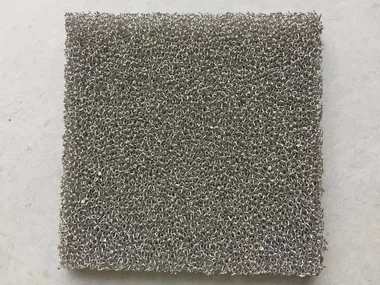
Research On Compression Plastic Mechanics Of Metal Foam Materials
Mar 22, 2022
With the development of the economy and the progress of the society, the industrial technology has developed rapidly. The development of composite materials and the exploration of new materials are important topics in today's industrial field. As a new type of material, compared with traditional metal materials and porous polymer materials, metal foam not only has the characteristics of functional materials, but also takes into account the characteristics of structural materials. It has obvious advantages and broad development prospects. Nowadays, foamed metal materials have been applied in many fields such as the automobile industry, construction industry, and aviation field, and have become one of the key topics of research in the field of new materials.
1. Characteristics of metal foam
Foam material has metal skeleton and pores. Compared with traditional metal materials, it has basic properties such as traditional metal weldability and also has a large number of internal pores. It is precisely because of the existence of these internal pores that foam metal has its own advantages.
1.1 Permeable
Because the metal foam has a large number of pores, but the number of closed cells also occupies a large proportion, because only the through-pore structure has permeability, so the closed pores have a great influence on the permeability. At the same time, the permeability is also related to the size of the pore size and the properties of the permeate.
1.2 Noise reduction and shock absorption
The through-hole structure existing in the metal foam can convert incoming sound waves and vibrations into heat energy and dissipate it. The performance of noise reduction and shock absorption is directly related to the height of its porosity and the size of its diameter. At the same time, foam metal is more durable than asbestos and other materials, and has higher strength and better flame retardancy.
1.3 Thermal conductivity
The thermal conductivity of metal foam is better than that of metal materials and lower than that of thermal insulation materials, and its thermal conductivity is directly related to its porosity. The closed-cell structure has better thermal insulation performance than the through-hole structure. Under convective conditions, increasing the porosity and expanding the pore size can improve the convective heat transfer capacity.
1.4 Electrical properties
Because of the pore structure, the damping is very good. If the high molecular polymer is filled in the pores, the damping characteristics can be effectively improved. For metal foams, the damping properties are directly related to the size of the surface area.
2. Structural form of metal foam materials
When people study and use structural materials, they must first consider the mechanical properties of materials. Therefore, mechanical properties are an important parameter for material performance evaluation. In order to conduct in-depth research on the mechanical properties of the material itself, people must first understand the structure and morphology of the material.
The main body of the metal foam material is the metal skeleton and the pores, and the pores include two types of through-holes and closed-cells. The through-hole structure is also called an open cell, that is, a single air hole inside the foam metal is open, and the air holes are connected to each other. The pores of the closed-cell structure are closed and independent of each other, and are separated from the parent metal. It should be noted that closed cells and open cells coexist in most metal foam content structures.
The support structure of slope metal can be divided into hole walls, ribs and joints. In the open-cell structure, the pores are interconnected, and the isolated pore walls are incomplete, while the closed-cell structure isolates the pores by the complete pore wall. When the pore wall is much thinner than that of the rib, the influence of the pore wall on the overall mechanical properties of the metal foam material is very weak, and it can be regarded as a quasi-open cell structure.
3. Compressive mechanical properties of foamed metal materials
3.1 Static Compression Behavior
The stress-strain curve of the metal foam material is divided into three stages (see Figure 1): the first stage is the elastic deformation stage, the second stage is the yield plateau stage, and the third stage is the collapse compaction stage. At the beginning, the strain is small, and the stress-strain centering is linear elasticity; then the strain continues to increase, and the stress is in a plateau phase, almost in a state of constant or small change, and finally, with the continuous extrusion of the internal holes of the foam metal material Pressed together, the material is in a compacted state with a rapid increase in stress. Under the action of compressive force, the deformation mechanism of the foam metal material is mainly the bending of the prism and the bending and stretching of the hole wall film. However, some holes in the material are weak themselves. When the strain is concentrated in a local position, the originally weak holes are first crushed under the action of extrusion, and then the adjacent holes are driven to continue to be crushed, forming a sequential transmission. The situation eventually led to the creation of the "deformation zone". With the continuous expansion of the "deformation zone", when the expansion and transmission of the failure stress affects the entire material, it is manifested as the entire material being crushed. It can be seen that the compressive plastic deformation of the metal foam material is successively destroyed by layer-by-layer transfer.
The experimental results show that when the metal foam material is subjected to the compressive force, the elastic deformation stage is very short, and when the strain reaches 2%, it will enter the yield plateau period, that is to say, for the metal foam material, The compressive yield stress and the yield plateau stress are equal.
3.2 Dynamic Compression Behavior
The shock-absorbing properties of metal foam make it a good shock-absorbing and buffering material used in many occasions. Researching the mechanical properties of metal foam under dynamic compressive load is a hot issue in the field of new materials. Compared with the mechanical properties under static compressive loads, the mechanical properties of dynamic compressive loads are more complex. Dynamic compression needs to fully consider a series of dynamic effects, including inertial effects and strain rate effects. According to the compressive deformation mechanism of the foamed metal material, the yield strength of the material is improved when the strain rate is higher. Under the condition of static compressive load, the metal foam material undergoes compression deformation layer by layer, and one layer of pore walls undergoes bending deformation, that is, the first stage of plastic deformation to the collapse of the second layer of pores. Under the action, it collapses layer by layer until all the pores are bent and compacted to a dense degree. This deformation process is not uniform and is unstable in a certain part. Then under the condition of dynamic compressive load, the stress increases and the material strengthening is mainly affected by two factors. One is that with the continuous increase of the impact speed, the pores on the impact surface are compacted more tightly, so that the yield stress increases continuously. The other is that dynamic compression has a prominent localization feature, which makes the strain rate of the compression plastic deformation zone increase, and the effect of micro-inertia results in the enhancement of the symmetrical and asymmetrical modes of deformation.