A Silent Cooling Revolution: How Metal Foam Eliminates Fans with Microcirculation
Oct 14, 2025
A Silent Cooling Revolution: How Metal Foam Eliminates Fans with "Microcirculation"
As electronic devices continue to soar in performance, heat dissipation has become a key bottleneck hindering their development. While the traditional "heat sink + fan" combination is effective, it also introduces issues such as noise, power consumption, dust accumulation, and extra space. A cutting-edge material called "metal foam" is quietly leading a silent cooling revolution with its inherently efficient passive cooling capabilities.
Metal Foam: The Extraordinary Properties of a Porous Skeleton
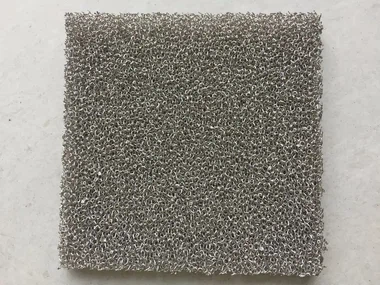
Metal foam, as the name suggests, is a metal material filled with countless bubble-like pores. Its structure is similar to a sponge, but it is made of highly thermally conductive metals such as copper and aluminum. This unique structure gives it three core advantages:
1. Large Surface Area: The micron-scale pores exponentially increase its internal surface area compared to the same volume of solid metal, creating a vast "stage" for heat transfer to the surrounding medium (such as air).
2. Excellent Thermal Conductivity: The metal skeleton itself is a good conductor of heat, rapidly transferring heat generated by a heat source (such as a chip) to every corner of the foam.
3. Structural Strength and Lightweight: While providing excellent heat dissipation capabilities, it is lighter than solid metal and possesses excellent mechanical strength, contributing to device weight reduction and structural optimization.
The Core Secret: "Microcirculation": The Active Cooling Engine Within Metal Foam
The most compelling advantage of metal foam lies not simply in its vast surface area, but rather in its dynamic, self-driven internal heat dissipation mechanism-"microcirculation."
This operating principle can be broken down into several steps:
1. Efficient Heat Absorption and Rapid Heating: When a heat source transfers heat to the metal foam skeleton, the air within the closed pores deep within the foam, closest to the heat source, is heated faster and more fully than the air in the surrounding areas.
2. Air Expansion and Density Change: According to the principles of thermodynamics, air expands in volume when heated, causing its density to decrease. This hot air, trapped in the overheated area, becomes "lighter" than the surrounding cooler air.
3. Natural Convection and the Formation of Microcirculation: Density differences generate strong buoyancy (Archimedes' principle). This buoyancy forces the hot air upward or outward through the intricate network of pores, while cooler air from the outside is drawn in from the bottom or other areas. This process occurs simultaneously and spontaneously within the thousands of pores within the metal foam, forming tiny yet extremely efficient convection circulation units.
This "microcirculation" effect is equivalent to constructing countless miniature, self-powered "nano-fans" within the material. Without requiring external energy, these nano-fans continuously draw core heat to the surface and dissipate it into the atmosphere, achieving heat dissipation efficiency far exceeding that of static, solid heat sinks.
From "fan-free" to "fan-free": The ultimate advantage of silent efficiency
It is this highly efficient "microcirculation" passive cooling capability that has made metal foam a leap toward eliminating fans in many applications.
· Extremely silent: Completely eliminating fan noise, it provides an ideal solution for high-fidelity audio equipment, quiet office environments, and medical equipment used at night. · High Reliability: The lack of moving parts eliminates the potential for fan failure, wear, or jamming, significantly improving system reliability and making it particularly suitable for harsh environments such as industrial control and aerospace.
· Zero Power Consumption and Energy Saving: The cooling process consumes no energy, effectively extending the battery life of battery-powered portable devices (such as high-end laptops and tablets) and IoT devices that demand extreme energy efficiency.
· Dustproof and Maintenance-Free: The enclosed cooling design eliminates dust accumulation on the fan, reducing maintenance requirements.
Application Prospects
Currently, metal foam cooling technology has begun to demonstrate its potential in a variety of fields:
· High-power LED lighting: Achieve efficient heat dissipation, extend LED life, and maintain stable light output.
· 5G communications equipment: Provide a compact and efficient cooling solution for core heat-generating components such as power amplifiers.
· Portable electronics: Enable silent cooling for future thinner, lighter, and more powerful mobile phones and laptops.
· Aerospace and defense electronics: Provide passive, efficient cooling in space-constrained applications with extremely high reliability requirements.
Conclusion
Metal foam, with its unique internal "microcirculation" mechanism, elevates heat dissipation from a passive behavior relying on external forces to an inherently active capability. It's more than just a new heat dissipation material; it represents a new heat dissipation philosophy-through sophisticated material structural design, it awakens the power of nature to achieve silent, efficient, and reliable temperature management. In the future pursuit of higher performance and enhanced user experience, metal foam will undoubtedly be a guiding light.