Applications and Technological Advantages of Foamed Metal Materials in Filtration and Purification
Sep 29, 2026
Applications and Technological Advantages of Foamed Metal Materials in Filtration and Purification
With the upgrading of new energy equipment and the continuous improvement of industrial environmental protection standards, traditional filter cotton, filter paper, sintered mesh, and ceramic filter media are gradually becoming unsuitable for complex working conditions requiring high temperature, high pressure, high precision, and long lifespan. Foamed metal, as a new generation of three-dimensional interconnected porous functional materials, achieves integrated filtration, flow uniformity, flame retardancy, and catalytic purification thanks to its stable metal skeleton structure, high porosity, and customizable characteristics. It has become a core material in the fields of hydrogen fuel cells, high-temperature flue gas treatment, and precision fluid purification.
I. Core Characteristics of Foamed Metal Materials
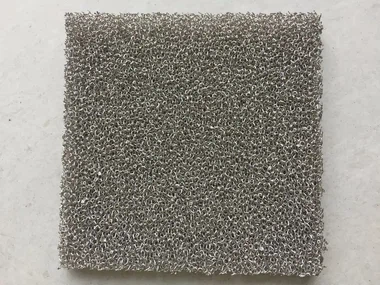
Foamed metal is manufactured using a metal sintering foaming process. Its internal structure is a three-dimensional interconnected network with a porosity of 70%–95%, uniform pore size, good air permeability, and low pressure drop. Compared to traditional filter media, it boasts the following significant advantages:
- No fiber shedding, stable structure, and resistant to deformation under long-term high-pressure airflow impact;
- High temperature resistance and oxidation resistance, capable of continuous operation under medium to high temperature conditions;
- Washable, regenerable, and reusable, significantly reducing equipment consumable costs;
- Customizable size, pore size, and alloy material, adaptable to modular equipment assembly.
II. Core Advantages of Foamed Metal Filter Materials
1. Strong Adaptability to High Temperature Conditions
Mixed polymer filter media generally have a temperature resistance below 120℃, making them unsuitable for high-temperature gas purification. Foamed metal can operate stably in medium to high temperature environments for extended periods, suitable for continuous filtration of reformed gas, high-temperature flue gas, and heat flow systems.
2. Recyclable and Regenerable, Lower Maintenance Costs
The rigid metal structure is resistant to erosion and corrosion. After clogging, it can quickly restore its permeability through backflushing, ultrasonic cleaning, and high-temperature burning. Its service life far exceeds that of traditional disposable filter media, making it suitable for continuous industrial production scenarios.
3. Integrated Filtration and Catalysis (Core Highlight of Copper-Manganese Alloy)
Copper-manganese foam metal is a specialized functional material for hydrogen energy and exhaust gas purification. It not only intercepts dust, particles, and tar impurities, but the substrate itself possesses catalytic activity, simultaneously decomposing harmful gases such as CO, hydrocarbons, and VOCs.
A single component can complete both filtration and gas purification, simplifying equipment structure and improving system stability.
4. Uniform Flow and Stable Pressure, Protecting Precision Equipment
The three-dimensional porous mesh structure provides excellent gas distribution and uniform flow, evenly dispersing turbulent airflow and stabilizing pressure. This prevents excessively high local flow velocities from impacting and damaging the fuel cell stack and precision components, significantly improving equipment operating efficiency and lifespan.
5. Flame Retardant and Fireproof, Enhanced Safety
The metal skeleton dissipates heat quickly and conducts heat evenly, effectively blocking flame propagation. It possesses excellent flame-retardant and backfire-preventing properties, making it suitable for explosion-proof filtration in gas systems and combustion equipment.
III. Main Application Scenarios
1. SOFC/SOEC Fuel Cell Hydrogen Energy Field
Provides inlet filtration, reforming gas purification, and pressure stabilization for solid oxide fuel cells and electrolyzer systems. It is a key core component of hydrogen energy equipment, effectively protecting the fuel cell stack and improving power generation stability.
2. Industrial High-Temperature Flue Gas and Exhaust Gas Treatment
Applied to dust removal and waste gas purification in high-temperature flue gas treatment, incineration, and metallurgy industries. It has strong temperature resistance and high throughput, suitable for continuous environmental treatment conditions.
3. Precision Liquid Filtration
Suitable for removing impurities from heat transfer oils, chemical solutions, sewage, and molten metal. It can stably intercept suspended solids and solid particles, suitable for corrosive and high-temperature liquid conditions.
4. Compressed Air Purification and Oil-Gas Separation
Used in air compressors and pneumatic systems to remove water mist, oil mist, and microparticles, obtaining clean process gas and ensuring stable operation of precision equipment.
IV. Mainstream Material Selection Guide
- Copper-manganese alloy foam metal: Integrated filtration and catalysis, primarily used in hydrogen fuel cells and medium-to-high temperature exhaust gas purification;
- Foam stainless steel: High strength and corrosion resistance, suitable for high-temperature flue gas and heavy-duty industrial filtration;
- Foam nickel/foam copper: Excellent electrical and thermal conductivity, widely used in electrochemical, fine purification, and heat dissipation filtration scenarios.
Summary
Foam metals overcome the shortcomings of traditional filter materials, such as single function, poor high-temperature resistance, and non-renewability, making them an upgraded alternative material for new energy hydrogen energy, industrial environmental protection, and precision fluid filtration.
In particular, copper-manganese alloy foam metal, with its integrated catalytic filtration advantages, has become the preferred functional porous material for SOFC fuel cell systems and high-end exhaust gas purification equipment, and is also an important direction for the future domestic substitution of high-end industrial purification.