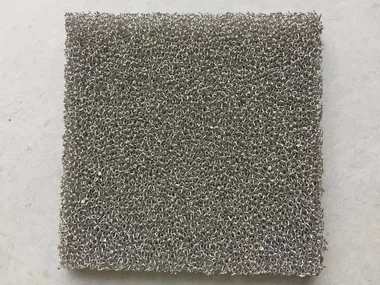
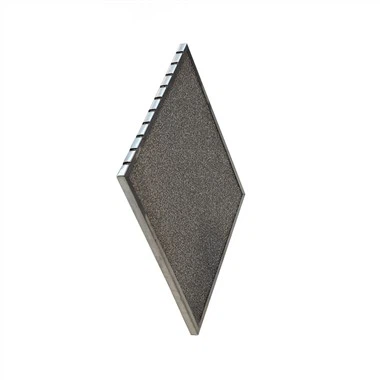
Foam nickel is a rising star in the porous metal family. After high-tech deep processing
Feb 10, 2025
Nickel foam, an innovative member of the porous metal family, is created through advanced processing techniques that transform metallic nickel into a three-dimensional fully interconnected mesh structure. With a density of 0.2–0.3 g/cm³-1/4 that of water, 1/3 of wood, 1/10 of aluminum, and 1/30 of iron-this lightweight material combines unique porosity and broad-frequency acoustic absorption properties. Its machinable nature allows for cutting, bending, and bonding, while exhibiting exceptional thermal conductivity (90–120 W/m·K). The homogeneous 3D network structure provides superior flow stability for gases and liquids, coupled with inherent filtration capabilities.
Structural Advantages
The nickel foam skeleton features a metallurgically bonded hollow framework with:
Ultra-High Porosity: 96–98% void volume
Ultralight Density: 1/50th of solid nickel (0.45 g/cm³ vs. 8.9 g/cm³)
Massive Specific Surface Area: 2,500–5,000 m²/m³
Inherited Nickel Properties: Corrosion resistance, thermal stability, and electrical conductivity
Multidisciplinary Applications
1. Electrochemical Power Systems
Battery Technology:
NiMH/NiCd battery electrodes doubling energy density
Carbon-nickel foam composites for lithium-ion anodes (2500 mAh/g capacity)
Fuel Cells: Catalyst substrates for PEMFCs and SOFCs
End Products: Smartphones, EVs (e-scooters to hybrids), power tools, and consumer electronics.
2. Chemical Engineering
Catalysis: High-surface-area substrates for catalytic reactions (TOF↑30%)
Separation Systems:
Oil/water and gas/liquid separators
Automotive exhaust scrubbers (NOx conversion >90%)
Filtration: Particulate filters for air purification and industrial processes
3. Electrochemical Processes
Water Electrolysis: Electrodes achieving 85% efficiency at 2 A/cm²
Electrometallurgy: Anode materials for metal refining
4. Thermal Management
Heat Transfer: Phase-change composite wicks for heat pipes (heat flux >200 W/cm²)
Thermal Interface Materials: Bonding layers for high-power electronics
5. Functional Materials
Acoustic Engineering: Broadband sound absorption (NRC 0.8–1.0 across 500–4000 Hz)
EMI Shielding: 60–80 dB attenuation from 1 MHz to 10 GHz
Advanced Applications:
Vibration damping in aerospace structures
Radar-absorbent layers for stealth technology
Flame-retardant building materials (UL94 V-0 rating)
Technical Highlights
|
Property |
Value |
Industry Benchmark |
|
Thermal Conductivity |
90–120 W/m·K |
Aluminum: 205 W/m·K |
|
Compressive Strength |
5–8 MPa (800°C) |
Ceramic Foam: 2–4 MPa |
|
Electrical Conductivity |
5,000–8,000 S/m |
Graphite: 3,000 S/m |
|
Hydrogen Evolution Rate |
2.5 L/h·cm² (1.8 V) |
Titanium: 1.8 L/h·cm² |