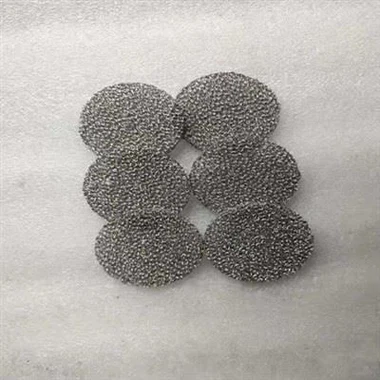
As a porous metal material, Ni-Fe foam has unique advantages in water electrolysis hydrogen production equipment, especially in alkaline electrolyzers
Apr 16, 2025
As a porous metal material, Ni-Fe foam has unique advantages in water electrolysis hydrogen production equipment, especially in alkaline electrolyzers. The following is a detailed analysis from the two aspects of application scenarios and comparative advantages:
I. Application of Ni-Fe foam in water electrolysis hydrogen production
1. As an electrode material
Cathode (hydrogen evolution reaction, HER): Iron-nickel alloy has moderate catalytic activity for hydrogen evolution reaction, especially stable in alkaline environment.
Anode (oxygen evolution reaction, OER): Nickel-based materials are classic catalysts for OER in alkaline electrolyzers, and iron doping can significantly improve their activity (such as Ni-Fe oxide layer).
Bifunctional electrode: Through surface modification (such as in-situ generation of NiFe hydroxide), HER/OER bifunctional catalysis can be achieved, simplifying the electrolyzer structure.
2. Support substrate
The three-dimensional porous structure of Ni-Fe foam can be used as a carrier to load other high-efficiency catalysts (such as Co, Mo sulfides or precious metal nanoparticles) to improve the overall performance.
3. Gas diffusion layer (GDL)
Its high porosity (70-95%) and conductivity facilitate electrolyte penetration and rapid gas escape, reducing overpotential caused by bubble blockage.
2. Comparative advantages of foamed iron-nickel
1. Compared with precious metal materials (such as Pt, IrO₂)
- Cost advantage: Iron-nickel resources are abundant, and the price is only one thousandth of precious metals, which greatly reduces equipment costs.
- Stability: Corrosion resistance is better than precious metals in alkaline environments (such as Pt is easily oxidized and deactivated in alkaline environments).
- Dual-functional potential: Precious metals are usually specialized in a single reaction (such as Pt for HER, IrO₂ for OER), while iron-nickel can achieve dual functions through component regulation.
2. Compared with traditional metal electrodes (such as stainless steel, nickel mesh)
- High specific surface area: The foam structure increases the effective surface area by dozens of times, exposes more active sites, and reduces current density overload.
- Mechanical strength: The porous skeleton has both flexibility and rigidity, which is better than the oxide-coated electrodes that are prone to brittle fracture.
- Mass transfer efficiency: Open pores accelerate electrolyte flow and bubble release, reducing concentration polarization.
3. Comparison with carbon-based materials (such as carbon paper, graphite)
- Conductivity: The intrinsic conductivity of metals (~10⁶ S/m) is significantly better than that of carbon materials (~10²–10³ S/m).
- Oxidation resistance: Long-term operation in alkaline environment has no carbon corrosion problems and longer life.
4. Comparison with transition metal oxides/sulfides
- Simple preparation process: Foamed iron nickel can be directly used as an electrode without complex coating or sintering processes.
- Integrated conductive substrate: Avoid the contact resistance problem between the oxide catalyst and the current collector.
3. Summary of core performance advantages
Characteristics Nickel foam Shortcomings of other materials
Specific surface area Three-dimensional porous structure (porosity>90%), many active sites Limited surface area of flat electrodes or dense materials
Conductivity Metal-level conductivity (10⁶ S/m), low impedance Poor conductivity of oxides/sulfides (need to rely on carriers)
Mechanical stability Resistant to high current shock, resistant to electrolyte corrosion (alkaline environment) Carbon materials are easy to corrode, and coatings are easy to fall off
Cost Cheap raw materials, scalable production High cost of precious metals, complex processing of carbon-based materials
Process compatibility Can be directly cut and formed, compatible with roll-to-roll manufacturing Brittle materials (such as ceramics) are difficult to process
4. Challenges and improvement directions
Despite its significant advantages, nickel foam still needs to be optimized:
1. Acidic environment restrictions: Currently mainly used in alkaline electrolytic cells, it is easy to corrode under acidic conditions.
2. Enhanced catalytic activity: Enhance intrinsic activity through surface nano-sizing, doping (such as Co, Mo) or composite two-dimensional materials (such as graphene).
3. Long-term stability: Continuous gas evolution may lead to structural collapse, and the pore structure design needs to be optimized.
V. Conclusion
Foamed nickel iron has become a highly competitive electrode material in alkaline water electrolysis hydrogen production due to its unique three-dimensional porous structure, high conductivity, low cost and easy processing. Especially in the scenario of industrial-grade high current density (>500 mA/cm²), its mass transfer and stability advantages are more prominent. In the future, through surface modification and structural optimization, it is expected to further narrow the activity gap with precious metal catalysts and promote the commercialization of green hydrogen production technology.