Analysis of the application advantages and market prospects of metal foam in the field of new energy
Apr 23, 2025
Analysis of the application advantages and market prospects of metal foam in the field of new energy
--High-performance material solutions to help achieve the goal of carbon neutrality
I. The structural characteristics of metal foam are highly consistent with the needs of new energy
1. Core characteristics
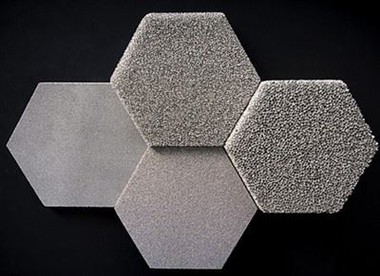
Three-dimensional porous structure: high porosity (70-95%) and through-channel design to achieve efficient mass transfer and improved reaction activity.
High specific surface area: The density of active sites per unit volume is significantly higher than that of traditional materials, suitable for catalysis and energy storage scenarios.
Lightweight and high strength: The density is only 1/10~1/5 of the same volume of solid metal, meeting the weight reduction needs of new energy equipment.
Customizable: Pore size (0.1-5mm), material (nickel/copper/iron-nickel alloy, etc.) are flexibly adapted to different application scenarios.
2. Pain points and solutions in the new energy industry
Battery energy density bottleneck → Foam metal electrode increases the loading amount of active substances.
High cost of hydrogen energy production and storage → Porous carrier optimizes catalyst utilization.
Equipment heat dissipation needs upgrade → Ultra-light and high thermal conductivity structural materials.
2. Core application scenarios of metal foam in the field of new energy
1. Battery technology innovation
Lithium-ion battery:
Three-dimensional current collector: nickel/copper foam is used as the positive and negative electrode substrate to alleviate the volume expansion of charge and discharge and improve the cycle life (experimental data: capacity retention rate > 85% after 3000 cycles).
Solid-state battery: porous metal support promotes uniform deposition of lithium ions and inhibits dendrite growth.
Fuel cell:
Gas diffusion layer (GDL): copper/nickel foam realizes efficient distribution of hydrogen and oxygen gas and liquid water management.
Lightweight bipolar plate: iron-nickel alloy foam replaces graphite, which has both corrosion resistance and conductivity.
2. The whole hydrogen energy industry chain
Electrolysis of water to produce hydrogen: nickel-based catalyst carrier (such as NiFe-LDH) reduces overpotential and increases current density by 30%-50%.
Hydrogen storage system: metal foam composite hydrogen storage material improves adsorption rate and safety.
3. Photovoltaic and energy storage system
Solar thermal conversion: black copper foam selective absorption coating, photothermal efficiency of more than 95%.
Supercapacitors: high specific surface area electrode materials achieve fast charging and discharging (10-second response).
III. Market prospects and policy drivers
1. Market size forecast
According to the Global Financial Report, the global foam metal market will reach US$1.2 billion in 2023, with the new energy sector accounting for more than 40%, and a CAGR of 8.5% is expected from 2023 to 2030.
China's "14th Five-Year Plan for the Development of New Energy Storage" clearly promotes high-safety and low-cost energy storage technologies, and the demand for foam metal electrode materials has surged.
2. Technology iteration trend
Combination: metal foams are combined with carbon materials and ceramic coatings to expand high temperature/corrosion resistance scenarios.
Intelligent manufacturing: 3D printing technology achieves precise control of pore structure to meet customized needs.
IV. Our company's core competitive advantages
As a professional manufacturer with 15 years of deep research and development of foam metals, we are committed to providing new energy customers with:
Full-process customized services: a one-stop solution from material ratio, pore design to post-processing (plating/sintering).
Cost optimization capability: The original electrolytic deposition process reduces costs by 30% compared to the traditional powder metallurgy method.
Successful cases: We have provided mass production-grade foam metal materials to more than 20 power battery/hydrogen energy companies around the world.
Driven by the goal of carbon neutrality, foam metal is becoming a key material for upgrading new energy technologies with its unique structural advantages. Feimite New Materials Co., Ltd. will continue to promote material innovation and work with industry partners to explore an efficient and sustainable energy future.
Contact us now to get customized foam metal samples and technical solutions!