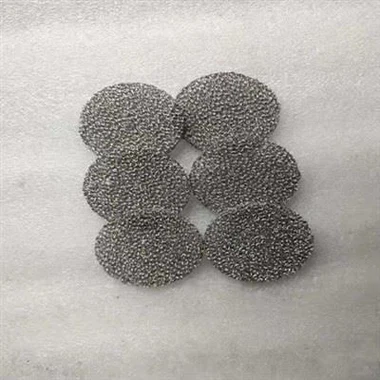
Nickel foam is a porous metal material with a three-dimensional mesh structure
Jun 16, 2025
Nickel foam is a porous metal material with a three-dimensional mesh structure. Due to its high porosity, large specific surface area, good thermal conductivity, excellent mechanical strength and metal stability, it shows unique application potential in molten salt heat storage systems, especially in enhancing heat transfer and optimizing system performance. The following are its main application directions and technical advantages:
I. Core application scenarios
1. Enhanced molten salt heat transfer performance
- Problem: The thermal conductivity of molten salt is low (usually 0.5-1 W/m·K), resulting in limited heat storage/release rate.
- Solution: Nickel foam is embedded in molten salt as an efficient thermal conductive skeleton:
- Its metal skeleton (nickel thermal conductivity ≈ 90 W/m·K) forms a fast heat conduction path, significantly improving the equivalent thermal conductivity of the composite material (can be increased by 3-10 times).
- The three-dimensional network structure increases the contact area of molten salt and enhances convective heat transfer.
2. Support for shaped composite phase change thermal storage materials (PCMs)
- Problem: Solid-liquid phase change materials (such as high-temperature molten salt) flow after melting, requiring container packaging and slow heat transfer.
- Solution: Infiltrate molten salt into the pores of nickel foam to form a shaped composite PCM:
- The porous structure of nickel foam locks the liquid molten salt through capillary force to prevent leakage.
- The metal skeleton accelerates the transfer of heat to the inside of the molten salt and shortens the phase change time.
3. Filling medium in molten salt storage tanks/heat exchangers
- Filling nickel foam modules in the flow channel of heat storage tanks or heat exchangers can:
- Increase the degree of turbulence, destroy the molten salt boundary layer, and improve the convective heat transfer coefficient.
- Extend the molten salt flow path and improve the heat exchange efficiency.
2. Detailed explanation of technical advantages
Characteristics Gains to molten salt thermal storage system
High porosity (85%-95%) allows a large amount of molten salt to be impregnated while maintaining structural stability. Large specific surface area Significantly expands the contact area between molten salt and heat transfer medium, and enhances heat transfer.
Excellent thermal conductivity Rapidly transfers heat to the inside of molten salt, reduces thermal stratification, and increases heat storage/release rate.
High mechanical strength Withstands high-temperature molten salt erosion and thermal cycle stress to avoid structural collapse.
High-temperature corrosion resistance Nickel has good stability in conventional molten salts (such as nitrates and chlorides), extending service life
(impurities such as sulfates need to be controlled).
III. Challenges and coping strategies
1. Molten salt corrosion problem
- Risk: Under long-term high temperature, molten salt (especially when containing impurities) may corrode the nickel matrix, resulting in structural weakening.
- Solution:
- Select high-purity molten salt (such as Solar Salt).
- Surface modification (such as Al₂O₃ coating) to improve corrosion resistance.
- Develop nickel alloy foam (such as Ni-Cr) to enhance corrosion resistance.
2. Cost control
- The cost of nickel foam is relatively high, and the application form needs to be optimized (such as using it only in key heat exchange areas, or adopting a gradient composite design).
3. System integration design
- The pore structure (PPI value), filling rate and layout of nickel foam need to be optimized to balance the pressure drop and heat transfer efficiency.
IV. Practical application cases
- Solar thermal power generation (CSP) heat storage system: Set a nickel foam filling layer in the molten salt tank to improve the power generation efficiency at night.
- Industrial waste heat recovery: Use nickel foam/molten salt composite PCM modules to recover high-temperature exhaust gas waste heat.
- Nuclear energy system: As a heat transfer enhancement medium in molten salt reactors, improve energy transfer efficiency.
V. Future development direction
1. Develop composite coating nickel foam (such as Ni-Al₂O₃, Ni-SiC) to improve corrosion resistance.
2. Gradient pore structure design: Optimize the pore size distribution along the heat transfer direction to reduce pressure drop losses.
3. Combined with nanofluids: Add nanoparticles (such as Al₂O₃ nanoparticles) to the molten salt to further enhance heat transfer with nickel foam.
Conclusion
Nickel foam effectively solves the heat transfer bottleneck problem in molten salt heat storage through its unique three-dimensional heat conduction network and structural stability. Despite the challenges of cost and corrosion, it has clear application prospects in high-temperature heat storage, rapid response and compact system construction through material optimization and system design, and is particularly suitable for scenarios with strict requirements on storage/release rates (such as CSP power plants and industrial process thermal management). Future research will focus on improving its long-term high-temperature stability and economy to promote large-scale applications.