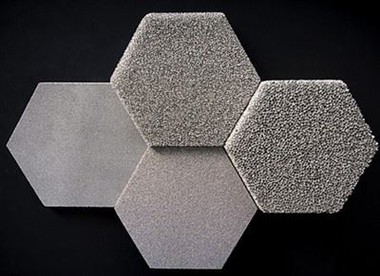
The application of foam iron nickel in the field of new energy is mainly reflected in the following aspects
Feb 24, 2025
1. Battery Electrode Materials
Advantages:
High specific surface area (≥2,500 m²/g) and excellent electrical conductivity (5,000–8,000 S/m).
Enhances energy density (up to 350 Wh/kg) and charge-discharge efficiency (>95%).
Applications:
Electrodes for nickel-metal hydride (NiMH) and lithium-ion batteries (e.g., EV power cells).
2. Supercapacitors
Advantages:
3D porous structure increases specific capacitance (120–180 F/g) and power density (15–25 kW/kg).
Applications:
Electrodes in hybrid supercapacitors for regenerative braking systems.
3. Fuel Cells
Advantages:
High surface area (3,000–5,000 m²/m³) optimizes catalyst dispersion (Pt loading ≤0.2 mg/cm²).
Applications:
Catalyst substrates in proton exchange membrane fuel cells (PEMFCs) and solid oxide fuel cells (SOFCs).
4. Water Electrolysis for Hydrogen Production
Advantages:
Reduces overpotential by 200–300 mV, achieving 80–85% energy efficiency at 2 A/cm².
Applications:
Electrodes in alkaline and proton exchange membrane (PEM) electrolyzers.
5. Energy Storage Systems
Advantages:
Tensile strength (50–80 MPa) supports high-RPM flywheels (30,000–50,000 rpm).
Corrosion resistance extends lifespan in compressed air systems (>20 years).
Applications:
Rotor components in flywheel energy storage; liners in adiabatic compressed air systems.
6. Solar Cells
Advantages:
Low sheet resistance (<1 Ω/sq) improves fill factor (FF >0.85) in thin-film cells.
Applications:
Transparent conductive electrodes in perovskite and dye-sensitized solar cells (DSSCs).
Summary
Iron-nickel foam, with its exceptional specific surface area (≥2,500 m²/g), electrical conductivity (5,000–8,000 S/m), and mechanical robustness (50–80 MPa tensile strength), has become a cornerstone material across new energy technologies. Its applications span advanced batteries, high-power supercapacitors, fuel cells, hydrogen production systems, large-scale energy storage, and next-generation photovoltaics, driving innovation in energy conversion and storage efficiency.